





Understanding the theory of capital structure Modigliani and Miller (MM Model)
Many theories attempt to assess the price of a company. Some are based on company debt, based on company assets, and others. Modigliani & Miller’s theory of capital structure is or MM Model is one theory that seeks to assess the company’s price. This theory does not relate the company’s capital structure to the company’s price, but the value of the company solely depends on the company’s operating profit. So however the company’s capital structure, whether the capital is obtained from debt or from the sale of shares or equity, has no effect on the value of the company, what matters is the profit that is able to be generated by the company.
Previously, many analysts associated debt with the fair value of the company. Large debt is considered to reduce the value of the company. Even though the debt does not affect the value of the company, what matters is the company’s ability to generate profits. Many have debt if they are able to generate large profits, it is not a problem. On the other hand, funding a company by selling shares is not always good, because selling shares results in diluting the shares held by the old shareholders. But like that, most of the company’s structure comes from debt or comes from equity, which is not related to the value of the company. The value of the company is related to the operating income of the company.
In financing the company’s operations, there are three alternative financing options that the company can choose, namely first by borrowing money from other parties, for example by applying for credit to a bank, or issuing bonds in the capital market. The second alternative is by issuing new shares which are sold to the capital market, and the funds from the sale of these shares can be used by the company to finance its operations. And the third alternative is by investing the profits the company gets for expansion (company operations). In practice, modern companies do a combination of these three things. So they issue new shares, borrow money, and invest their profits. Regardless of the company’s steps in funding its operations and however the company’s capital structure, the value of the company does not change if the company’s profits do not change because of this alternative funding action.
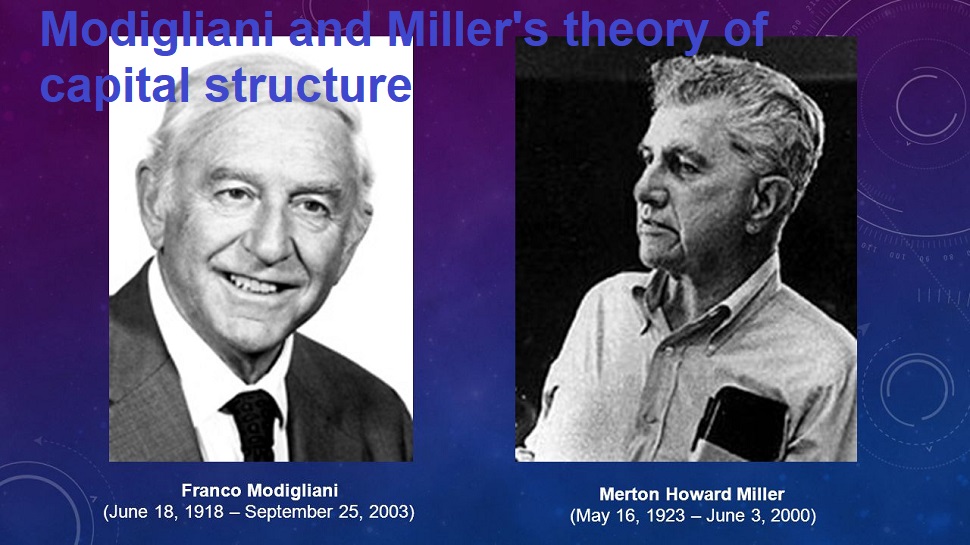
Modigliani and Miller’s theory of Capital Structure or MM Model is talking about the relationship between capital structure and the market value of a company, which states that the market value of a company will completely depend on the profits generated by the business both for now and in the future. not on the capital structure. Well, this theory itself is the result of the thinking of Merton Miller and Franco Modigliani, both of whom are professors in the Graduate Program in Industrial Administration at Carnegie Mellon University. This concept was then outlined in an article entitled “The Cost of Capital, Corporation Finance and the Theory of Investment” and published in the American Economic Review in the late 1950s.
So, what is the core theory of the MM model developed by Modigliani and Miller?
Look… basically a company or business generally has 3 methods or ways to get funding or capital to finance operational activities, or which will be used for business expansion, among others, the first is the easiest for example by issuing debt securities or bonds, this is means funding from loans or debt, then the second is by issuing new shares or rights issue either without pre-emptive rights (PMTHMETD) or with pre-emptive rights (HMETD), and the third is by reinvesting the profits or profits have been obtained in business with the hope of increasing profits in the future.
Well, according to the theory put forward by Modigliani and Miller, whatever options are taken by the company to support its business capital, it will not affect the actual market value of the company, but will depend on the profits generated by the business. The rationale of Modigliani and Miller is actually similar to the Net Operating Income Approach which states that the company’s valuation is not relevant to the capital structure, and the market value of the company has nothing to do with the proportion of debt to capital, with the proposition that any profit earned the increase in debt, which costs less, will be offset by a higher rate of return on equity.
Furthermore, Modigliani and Miller argue that the market value of a company or business will be affected by its operating income, regardless of the risks involved in the investment and has no relevance to how and from where the company finances its business operations. The assumptions used by Modigliani and Miller’s approach are that there is no tax burden and tax dividends, no securities or securities transaction costs and bankruptcy costs, symmetrical information means that both companies and investors have access to the same information so that they can encourage each other. To behave rationally, both investors and companies are charged the same loan fees, and there are no floating costs, such as underwriting commission fees, bank fees, advertising fees, and so on.
From the theory presented by Modigliani and Miller, it can be concluded that the value of a company or business that uses leverage or leverage on its capital, for example by combining equity with forest, will be the same as a company that does not use leverage where business activities are fully financed by equity. non-debt with the same record of business profits and future prospects. In this case, the costs incurred by investors to invest in the company’s shares with or without leverage will be the same.
In conclusion, Modigliani and Miller Based on two assumptions of capital market integrity and the fact that firms and investors can borrow and lend at risk-free interest rates, firm value is based on the future cash flows generated by assets, and there is no optimal capital structure.
In other words, Modigliani and Miller are two professors who studied capital structure in the 1950’s basically stating that capital structure in a very good market has no importance for firm value. Thus, net activity has the same premise as the income approach. The Modigliani-Miller approach shows that firm value is related to operating income and the risk associated with its assets.
Thus it has perfect market criteria: no taxes, no transaction costs, no bankruptcy costs, and reduced information asymmetry.